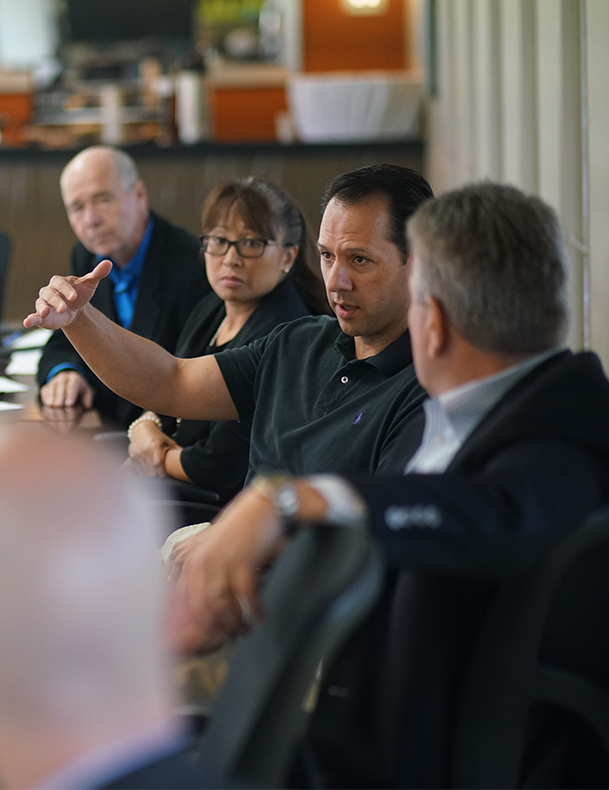
Top headerThe Academy for Chief Executives homepage
The Academy for Chief Executives homeSpeakersSearch
JOIN THE ACADEMY
 Become a Member
Meet the Board you could never afford and become a better business leader, while growing professionally and personally.
 Become a Chairman
Help to inspire, mentor & challenge other business leaders to grow & achieve their business & personal goals, while achieving yours & reaping financial rewards.
blog header

Non carpe diem! Or, why it can be so difficult to take action

I have a client – or, rather, I don't have a client – who, despite being granted funding from Train to Gain for coaching, has still not booked the first session after four months.

Then there was the company, one of whose directors wanted me to coach the board in time management and planning, who never got round to appointing me because the subject was too far down their board meeting agendas and they never reached it.

Then again, I had a client, a very successful service provider whose turnover had plateaued: they fervently wanted to grow the business and, indeed, in the early days they had been able to do just that.

Why do people not take action they know is necessary and is completely within their abilities?

Let's put aside the businesses who don't take action because they don't know what it is. They don't have a plan so they might want the business to grow but they haven't worked out how it should happen.

Then there are those who have planned – or at least thought about the progress of their business – but they haven't taken action because they don't know how. They lack skills which they can acquire or buy.

I'm talking about businesses who, like the service provider above, know what to do and how to do it, but they just aren't doing it. Or they are doing it (they think) and it's still not working. Or businesses who use the behaviour they need to overcome as the excuse for not tackling that very behaviour.

The MD of the service provider was genuinely bemused that the business wasn't growing and, being a rational man, had explained the situation in terms of two, somewhat questionable, beliefs. The first was that 'in order to grow a business, you need big clients' and the second was 'we don't know how to get big clients'. So, he employed me to teach him to get big clients. Which I did. Unsurprisingly, no big clients materialised.

With businesses that are stuck in this way, sooner or later I get round to the question 'So how comes it suits you your time management is appalling/you're not putting on clients/you're pathologically busy/etc?' When it is first encountered, this is a highly counterintuitive question.

However, I stick to the notion that, whatever people do – however bizarre, against their own interests, or even wrong – at least part of the reason for doing it is that they get a positive benefit somewhere along the line, even if they're unaware of it.

And the first benefit is that some people have to stay in their comfort zone, to do only what they're familiar with, even if it doesn't bring the results they want or need. Doing something different is just too risky.

What is outside the comfort zone? Certainly, if you believe it will be bad out there, it will be. Better to have a new model. Map the comfort zone idea onto a standard model of stress and you'll see that the comfort zone is equivalent to the safe, but relatively unproductive first stage. The second stage of the stress model is an area where the individual is under pressure – not stress – and, arguably, is working at his or her best. Adrenalin is raised, there is excitement, a buzz in the air and far more gets done – and done well. So think of a stretch zone outside the comfort zone and actively enter it.

There's no doubt that, when a business owner is failing to take action, the effect will show up in other people in the business. There will likely be other behaviours going on: 'busyness' – lots of activity, not much progress – and an emphasis on roles, rules and duties underlying the comfort zone stuff. These behaviours, which may show up more or less strongly, have an element of inauthenticity about them.

Underlying them… is doubt. Doubt that the business will be a success, doubt that people will buy from it, doubt that people will like the business owner – all sorts of doubt. Doubt, which again may be more or less strong, but whose origins you can be certain lie well before the business was started.

The business whose sales had plateaued started to grow after the business owner suddenly realised, in coaching, that he hadn't trusted himself to run a bigger business. He had been subconsciously ensuring that the business stayed at a size he was comfortable with.

Whilst there are many ways successfully through the doubt phase, here's a remedy that's suitable for all. In Indiana Jones and the last crusade, Jones is standing at the edge of a deep chasm. On the other side is the holy grail, but there appears no way across. Luckily Indiana has a parchment showing an old drawing of a man apparently walking on air. "This must be a leap of faith", he says. So he steps out into the chasm only to find a bridge under his feet, and soon the holy grail is in reach.

In Susan Jeffers immortal words: feel the fear and do it anyway.

©2010 Jeremy Marchant

www.emotionalintelligenceatwork.com

Jeremy Marchant is a business coach, trainer and mentor. He is an NLP master practitioner and CBT practitioner and has received extensive training from Psychology of Vision. As part of the Academy Speaker Community, Jeremy has helped to provide new thinking, new ideas and best practice to a growing number of business leaders in the UK.


Whatever you want to do, there's probably an app for that.

Did you know that mobile phones now outnumber PCs worldwide by 4:1?

Couple that with reports that 25% of all phones sold by Vodafone in the run up to Christmas were Smartphones and it's clear that the unrelenting explosion in the mobile market shows no signs of abating anytime soon.

At the Mobile World Congress event in Barcelona this month there were, as usual, a multitude of launches and announcements neatly summarised in TechRadar.com's review where it declared Legend and Desire handsets from HTC, Google's Flash for Android and Microsoft's Windows Mobile 7 to be the headline winners at the show.

As more and more devices become available in the Smartphone category, and with mobile web access now increasingly commonplace, the opportunities for mobile content delivery are finally being realised.

iPhoners can already access news content for free via Sky and the Daily Telegraph's apps or from the Guardian for £2.39 and from April, the BBC will also be offering news and sports content for free through an iPhone app (followed by versions for Blackberry and Android) adding increased pressure to the news industry's struggle to find a digital business model.

apps for the appleThere are now more than 120,000 apps available from Android and Apple able to offer solutions to previously unthought-of of problems. So if you want to access the in-flight status updates for a friend or loved one, you need FlightTrack. Regularly forget the floor or area where you've parked your car? Don't worry; cAr Locator will help you find it. Want to know the name of a piece of music you're listening to? Hold your Smartphone up to the music and Shazam will identify the song.

In the business environment, there are applications like Cardreader that will import business card details directly into your contacts and iDialUDrive which will automatically call, one by one, all contacts in a customised list when you are on the road.

Basically, in the world of mobile, if you want do something, there's an app for that.

For personal-use mobiles, keeping track of downloads that incur a charge is important to stay on top of monthly expenditure and prevent being too shocked when the bill arrives.

In the business environment this is imperative. Micro-purchases can now be made regularly using mobiles with the cost appearing on the company mobile bill; in a world where the Smartphone is heading towards centre stage, the number of items that could be non-business or telecoms related need to be identified and allocated to the appropriate cost centre.

Within any organisation, there was always an element of the mobile spend that was variable whether it was roaming charges, data downloads or simply reaching the allocated minutes in a monthly package but the rapid growth of mobile web has escalated the scale of these variable costs.

Although the forecasts for Telecoms budgets by Gartner are looking slightly more optimistic (a predicted increase of 4.7% in 2010), managing telecoms costs should remain a priority for both private and public sector organisations. With the potential to deliver average savings of 15% on current spending, watching those small mobile items could contribute positively to the growth plans for your company. Now I wonder, is there an app for that?

Paul FeganPaul Fegan is Managing Director of Mala Communications and has been a member of The Academy for Chief Executives for 3 years. The benefit of shared experience and self development are Paul's main reasons for membership of industry programmes such as The Academy and in addition Paul is the chair for the Telecoms Cost Management forum within the CMA (Communications Management Association).


Action for Lasting Change

This week, I want to use some of the ideas from Jim Collins' book Good to Great to explore making changes that really stand the test of time. For the purpose of this article, I'm going to assume that you know where you want your business, or your life, to be. If you don't have a strategy, then take a look at Jeremy Thorn's excellent articles (part 1 appeared in the blog last week and part 2 is in this week's). The more clearly you and those around you can see, hear and feel that destination, the better. Knowing where you want to be is good, clarity around the details of that is better.

The destination is one element of plotting a journey. The other, of course, is to know where you are starting from. So where are you now? Take the time to review and assess your position and seek feedback from internal and external sources. For now, accept that feedback whether it is good or bad. No matter how wrong it may feel, the feedback probably comes from a valid point of view.

The easy part of working with that feedback is to build on the good stuff. We all like to hear about what's working and what people like about what you are doing but if it is all working well, where is the need to change? There is almost certainly going to be some less than good stuff, maybe some bad stuff in the mix, too. Often, we are less than comfortable about receiving bad news but shouldn't you know about something that may reflect poorly on your company? Of course you should and your reaction to it will determine how honest that feedback will be. The more honest the feedback, the more clarity there will be about the true situation, as opposed to the one you'd like to be the case and the more the right decisions will become self evident.

Many businesses develop a culture, whether deliberately or accidentally, where the truth is not encouraged. Management choose to live in denial of the brutal facts that relate to their market, people, products or performance. The culture that works best when developing a company is one where people – staff, clients, customers, suppliers and advisors -can not only be heard but are encouraged to speak up In order for the truth to be heard. To do this, lead with questions, rather than answers, engage in dialogue and debate, not coercion, and conduct autopsies without blame.

Reputation depends not on words but on actions. How you respond to adversity can help to make the difference between good and great. Hitting the realities head on can also give you the edge over competitors who fail to see the reality or to act upon it. Companies who can retain an absolute faith in their ability to succeed whilst confronting the real situation and taking corrective action are more likely to make big improvements in their performance than those who are in denial over the reality of their position.

Once you know where you are going, where you really are now and what needs to change to get there, you can begin to build momentum. It takes a lot of effort to get the change moving but less effort once momentum is building. Jim Collins refers to this as 'the flywheel'. People inside the business are often unaware of the magnitude of the transition that is happening when change is progressive and consistent. It is steady cumulative effort rather than frantic activity that leads to breakthrough. It is important to stay true to the objective and the destination. True momentum takes time to build and seconds to destroy. 'Chopping and changing' the destination or the route that gets you there often results in no progress at all.

When you can see that you are close to achieving your destination, make sure you know plan your next destination. Don't lose momentum at that point, be ready to keep moving on towards the next destination. If the direction in which you are moving is the same for the next destination, so much the better for your progress.

Perfect preparation prevents poor performance. Time spent in planning is seldom wasted so long as you do take some positive and consistent action.

Brian Chernett is founder of The Academy for Chief Executives (ACE) - He has 43 years' experience as managing director of private and public companies, including subsidiaries of Booker Bros McConnell, the Landmark Group, and several other major companies. Find out more at our membership page.

The Academy community provides a great place to build your leadership skills and learn more about motivating and developing your people, and how to focus the top team for the good of your company. As the leading providers of experiential learning, the purpose of the Academy is to inspire leaders to achieve their dreams by sharing and learning from real life experiences.


DO YOU HAVE A STRATEGY? (- or 'Thinking Around Corners) - Part 2

PART 2 – CREATING YOUR STRATEGY

Now is a great time to 'spring-clean' your organisation's strategy. In Part 1 of this article last week, we explored how having a Strategy, before first determining clear Goals and Objectives, might be as unhelpful as taking Action before determining a Plan. (And you wouldn't want a Business Plan without first having an under-pinning Strategy, would you!)

What follows is the essence of many proven strategic planning frameworks. You can start anywhere. But do note from the seven tips already offered, strategic planning may never be complete. The 'Goal' is your destination – 'strategy' is only the means of getting there more securely!

CORE COMPONENTS

  1. Mission, Vision and Values
    a) Do we have an agreed, over-arching, core 'purpose'/'mission'.
    Is it explicit, credible and realistic? And does it really describe what everyone wants to achieve?
    You aren't looking for 'fine words' here – you need to describe accurately and unambiguously what you want to achieve. That often requires really open-minded challenge and honesty from within the team.
    For example, do we want to grow, stay the same or get smaller?
    Do we want to specialise at all, and if so, in what, when, where and how?
    Questions far better sorted out now rather than later!

    b) Do you have a shared 'vision' of what success will look like,
    to 'think around corners'?
    - the foundation of all good leadership?
    So where are we all going? – what will it feel like when we get there? – will we all be happy with it once achieved? – what will we do if we don't?

    c) Do we all have really clear values for our organisation, by which all decisions may be guided and will stand against any short-term expediency, knee-jerk reactions or unhelpful ambiguity?

    Clarifying all the above can take more time than any other part of this process, and requires tact, sensitivity, honesty and trust. But working through these questions, especially as a top team initially, should set the foundation for all that follows.

  2. The External Environment, Consumers and Stakeholders
    a) The big picture?
    When you start this strategy-development process, you may well want to explore this topic first as part of your preliminary data-gathering.
    Have we covered the whole external environment that affects us? Have we explored all possible realistic scenarios?
    There may be no clear answers – but one of the secrets of good strategy development is to ask really great questions! (Another is to keep challenging the answers!)

    b) Who do we want to serve?
    Who are they? What do we know about them? How satisfied are they? What more would we like to know about them?
    Who else could they be? Where are they? What do they want, what do they need, what do they currently get?
    (Are these very obvious questions to ask? Not often!)

    c) What about other external stakeholders? - such as funders, suppliers and wider partners.
    Again, who are they, who could they be, what do they want, how can they help us?
    How are our external relationships? Could we help to make them better and more productive? Do we even want to? (And if not, why not?)

  3. The Internal Environment – Key Resources, Services, Competencies and Structure
    a) What key resources will we need to deliver these services? For example: funding, infra-structure, systems, equipment and premises. And what about the human resources, of management and staff (and even their own families?). Are their goals, objectives and values all aligned?
    What works well and what doesn't? What may not work so well in the future and what could be changed for the better?
    This topic can often become tactical. But it may also be mission critical

    b) What services do we want to offer? They are probably the core focus of all that we do. But are they right and fit for purpose. Could they be better, are they complete, should some even be dropped? And do they all meet the Mission, Vision and Values? When it comes to emotional resistance within a team, this section can be the most fraught! ("But we have always done…" "We could never do…." Even, "I don't now how to …." – which you should only ever ignore at your peril.)
    Few of us like change, and an imposed change in services can be deeply destructive for any team without great care and attention. But ignoring new services may be an organisational death-warrant. So tread carefully!

    c) What core competencies will we need? What new skills and behaviours may we most admire and require, what existing ones will we need to develop? How can these best guide our future recruitment strategies – and maybe some exit strategies too?

    d) What organisation will we need to deliver all the above?
    Perhaps the current structure may not deliver the required Goals. But note? A great strategy is meaningless without a great organisation to deliver it!

CONCLUSIONS
If there are no shared goals and objectives at the top, further strategic exploration may be meaningless until agreed.

The process described is invaluable, especially in resolving disagreements, but take it slowly, and don't try to do this all by yourself? Skilled, neutral facilitation may help to get you started, but don't forget to engage all those who will have to deliver your strategy? Creating a winning strategy is much easier than delivering one and you will need their engagement.

Above all:
Think Ahead; Think Aloud; Think a Lot; and Think Again!

Jeremy Thorn is an experienced Non-Executive Director, Leadership Coach and top-team Workshop Facilitator for a wide range of organisations internationally.

He is particularly well-known for his work on strategic Top Team development and 'win-win' Negotiation workshops for members of the Academy for Chief Executives and many others.

Author of several prize-winning business books, Jeremy is the past founding Chairman of QED Consulting and previously Managing Director of a large international engineering company. www.JeremyThorn.co.uk

As part of the Academy Community, professional speakers, such as Jeremy, witness first hand the power of leaders learning with leaders. The Academy process, experiential business learning, provides a unique environment for CEOs and MDs to hear how other leaders are developing their businesses and themselves, and how they are motivating their own people. Academy Membership – find out more >>

Copyright: Jeremy Thorn, 2010


Why is now the time to sell your business?

One tablespoon of hindsight, a dash of hope and a sprinkling of luck. The perfect recipe for a successful business sale? Sadly, not ingredients readily available for your average entrepreneur wondering whether the conditions are opportune for a business disposal.

However, having bought and sold over 300 businesses in the last 20 or so years in economic periods both buoyant and depressed, even if I can't conjure up such tasty ingredients I do believe I have seen far worse conditions than those we are currently experiencing in terms of a business sale environment.

For one thing a lot of vendors have held back selling their company for a variety of reasons, this has meant that choices are limited for the acquirer. For another, anyone with cash, and oh yes there are plenty of companies with that precious commodity, are struggling to find homes for it, the punitive interest rates hardly being appealing and in any case the banking vehicle is barely secure.

The private equity market has been all but shut for 18 months or more and is at serious risk of alienating its own shareholders if they don't start investing very soon.

And of course the heavily speculated increases in CGT looms ever imminent.

The question is then; does such an appealing set of ingredients create the ideal selling environment?

For those vendors whose acquirers have either tradeable paper or spare cash then the conditions may be near perfect.

Alas for a debt based deal the vendor may need to take a more pragmatic view, not necessarily to value but certainly to the availability of a single cash out deal, with any form of bank debt being less likely than ever in 2010.

The barren M&A market will also give the shrewd business man or woman the chance to negotiate hard on professional fees. Many corporate lawyers have culled their departments and are seeking to maximise chargeable hours for those left behind. And where, for a more modest deal fees have been historically disproportionate, the chance to get fixed or contingent fees are far more likely as the professionals fight it out for the chance to secure the work.

So, should you put up your 'For Sale' sign? Certainly, if for no other reason than deal times are now loner than ever in this 'risk adverse' new decade.

Expect your sale to take up to 9 months or more so the sooner you get to market the sooner you should be able to exit it.

About the Author

Jo HaighJo Haigh is a Partner and Head of Corporate Finance for MGR a company based in London and Yorkshire and a partner in the fds Group, a specialist training and development business.

An experienced dealmaker, Jo specialises in putting together the right deal at the right time and in the right format for growing businesses throughout the country. She has bought and sold over 300 companies in the last 20 years specialising in owner managed companies.
More >>

www.mgr.co.uk
www.jo-haigh.com

As part of the Academy Community, professional speakers such as Jo provide excellent, practical and, in many cases, hard-hitting topics for MDs and CEOs. They know that by inspiring the leader of a business to change their thinking and to help them formulate an individual plan for the future, leaders develop themselves and grow their companies. Academy Membership – find out more >>


Taking action with purpose

I find some shade to protect myself from the sultry sun as I wait for my beautifully tailored salwar and the made to measure shirts for my husband. Three sewing machine operators are crammed into a tiny space packed with multi coloured materials. One operator is outside the shop with his treddle machine on the dusty lane that runs alongside this busy little enterprise. I am in India.

Six months ago this tailor was working from home driving to and from the resorts here in Kerala to pick up and deliver clothes for staff and tourists alike. He worked through the night to get the clothes ready for wedding or party deadlines. Nowhere do I experience entrepreneurial action the way I witness it here in India.

Four months ago the tailor bought his own first floor room to use as a shop, but out of sight it didn't attract the passing trade that he had hoped for. Within another two months he had sold that room, bought this open space on the road side and had expanded from being the one man band to the five man operation that I was witnessing now. He didn't delay by waiting to prepare a marketing or business plan. There were no courses that he 'needed' before he could get started. He was not dependent on any loans to get the site that he wanted… he alone made it happen.

If the decisions he makes don't pay off he makes a new decision, all the time checking that he is moving towards his goal to be the tailor to all the main resorts in the area and to be the first choice for all the locals for their festival outfits. In India there is no buffer of corporate shelter. The locals stand on the beach every morning to catch their food for the day. The only choice is to fish or go hungry…

What are you waiting for to act in line with your outcomes? How might you act now to move towards your vision and to be able to act quickly and flexibly if the decisions you make don't provide the immediate return you expect. We have a lot to learn from these '3rd world' countries and I wonder just where is that 3rd world now?

Sue is an author of NLP at Work (new 3rd edtion), international speaker, consultant and NLP Trainer. She works with leaders in all countries especially the UK, India and Australia. Read more at www.sueknight.co.uk

Sue has been at the heart of the coaching and mentoring capability of many of The Academy's leaders throughout the organisation's history and, as a speaker on using NLP in the workplace, has influenced and inspired many of the members, too.


DO YOU HAVE A STRATEGY? (or 'Thinking Around Corners')

PART 1 – GETTING STARTED

Spring is not just a time for 'spring-cleaning', but also for renewal. Now may well be an ideal time to dust off that dusty document in your bottom drawer labelled 'Strategic Plan', and see if it is still relevant.

Or maybe, is it even time to start with a new one?

We all have strategic choices to make about the world we live in. And after all, what professional organisation, let alone any sensible individual, might actually choose to be a cork on the ocean of life, bobbing around hither and thither, blown by the winds of random fortune?

So here is a very short question for you first – and I promise it isn't a tease.

How would you rank the following, in terms sequence and importance?

  1. Strategy;
  2. Actions;
  3. Objectives;
  4. Plans;
  5. Goals?

Do please answer this question for yourself, privately, before reading on?

Before we explore any 'right' answer, may we also agree that it is not only whole organisations that need a strategic plan?

Even elements of an organisation need a strategy, whether for operations, sales, finance, staff development, IT, internal and external stakeholder communications - and the rest.

PRELIMINARY THOUGHTS?

Strategic planning isn't just a management fad nor a 'nice-to-have'. But it certainly has no place without your first being absolutely sure of your core goals (and the subsidiary objectives you need to attain to achieve them on the way) - whether they are for growth, consolidation or survival; management succession, exit or retirement; or whatever.

Most organisations have an operational 'Business Plan', not the least to allocate resources and measure progress. But don't confuse your 'Business Plan' with a 'Strategic Plan'? They are very different. (If you have any doubt, just ask yourself: which of these two should come first? You wouldn't plan your actions first and then think of the appropriate strategy afterwards, would you?)

So might you agree that the 'right' answer to the question above is:

  1. Goals;
  2. subsidiary Objectives to meet those goals;
  3. Strategy;
  4. Plans;
  5. Actions

And once you know what you want to achieve and where you want to go, what then? You need a strategy!

7 KEY TIPS FOR STRATEGIC PLANNING

  • Do be patient. Great strategies rarely happen 'overnight'. They take much analysis and hard, creative thought.
  • Do your research. Strategic planning in a vacuum is pointless! Get as much data as you possibly to inform strategic insights. For example, what is actually happening in your world and what might everyone else be doing? Can you even find out what they are planning to do and what they are thinking? Marketing, Employee and Stakeholder Research truly costs so little relative to the benefits, and may be the best investment you might ever make.
  • Don't create a strategy on your own – be willing to share your thoughts as widely as you can with those you trust.
    Most organisations find that executing a successful strategy in practice is far harder than devising one in theory. Not the least, successful strategies need 'buy-in' from all those who are going to have to implement them with you.
    So engage as many of your key colleagues as you can, at an early stage, to gather their thoughts too. (And just as importantly, once the final strategy is developed, do share it with all involved. If they don't know what the strategy is, how may they ever help you to help achieve it?)
  • Raise your eyes beyond the current horizon. That means not only looking ahead beyond the present-day, even to 'dream the impossible dream' which is important; but also in detaching from any immediate vested self-interests, fond hopes and possibly self-limiting beliefs of yourself and those helping you, in reviewing all options.
    Not everyone finds this easy. Sometimes, it may be helpful to have a trusted, independent and objective facilitator to challenge these? But the eventual strategy must be yours and your teams, no-one else's!
  • Aim to 'break the mould' by doing something radically different from others to seek competitive advantage and make your strategy fully sustainable. 'Me too strategies' can be superficially very appealing, but not if all those who are fighting for the same markets, resources and mind-share as you are doing exactly the same.
  • Test your chosen strategies first - if you possibly can, not only with broad discussion but perhaps also with even some pilot tests for your more radical thoughts in particular? And don't forget? Every 'Plan A' might benefit from having a 'Plan B'!
  • Revisit your chosen strategies regularly. Times, people and circumstances readily change. Most winning strategies develop only after time, often quite unexpectedly. But often very productively.
  • Great strategies focus on the future, as much on 'what might be' as on what has happened in the past. That means 'looking around corners'. Great strategists also seek to include as many other views as they safely can, with deep reflection and continuous challenge. They also continue to 'go around the loop' in their strategy development, not the least to monitor their impact and gauge others reactions.

    So let your watch words be:
    Think Ahead; Think Aloud; Think a Lot; and Think Again!

    In Part 2 of this article next week, we'll look at a comprehensive framework to help you construct a really robust strategic plan in practice, whether for all of your organisation or just a part of it.

    Jeremy Thorn is an experienced Non-Executive Director, Leadership Coach and top-team Workshop Facilitator for a wide range of organisations internationally.

    He is particularly well-known for his work on strategic Top Team development and 'win-win' Negotiation workshops for members of the Academy for Chief Executives and many others.

    Author of several prize-winning business books, Jeremy is the past founding Chairman of QED Consulting and previously Managing Director of a large international engineering company. www.JeremyThorn.co.uk

    As part of the Academy Community, professional speakers, such as Jeremy, witness first hand the power of leaders learning with leaders. The Academy process, experiential business learning, provides a unique environment for CEOs and MDs to hear how other leaders are developing their businesses and themselves, and how they are motivating their own people. Academy Membership – find out more >>

    Copyright: Jeremy Thorn, 2010


    Time to be "Slicker" in 2010?

    Has your life ever been influenced by a film that you saw at the cinema or maybe on the TV whilst having your supper? In my case, the film was "City Slickers." If you know the film you will remember that three tired advertising executives head for Colorado to try and deal with their mid-life crises and "find themselves."

    It is an amusing film, but also a very moving one. The scene that had a dramatic impact on my life, at the time, is the "camp fire scene." The main character, played by Billy Crystal, is talking to a leathery old cowboy, played by Jack Pallance, who is scathing about the New-Yorkers' "pathetic little lives and material lifestyle."

    He says "…..You know, life is only about one thing of course"

    Billy Crystal looks up and eagerly says ………"You mean out here in the middle of nowhere you know the meaning of life?"

    "……Of course I do…………it is about one thing, as I said!"

    "Well, for God's sake tell me…………I've travelled thousands of miles to work this out so you must tell me………what is life all about?"

    "……As I said, son, just one thing and one thing only!"

    "……But what is that? ……….what is this one thing?"

    "……Son, life is about one thing and one thing only……….and that is for you to work out!"

    So how does this film clip affect you today – at both a business and personal level? What actions do you need to take to be "slicker" in 2010? Here are a dozen "one things" you may like to reflect on and discuss with your team:-

    1. What is your one main business objective this year?
    2. What is the one thing your business needs to do more of?
    3. What is the one thing your business needs to do less of?
    4. What is the one thing your business needs to be better at?
    5. What is the one thing you want prospects to understand when they arrive on your website?
    6. What is the one thing you want your existing customers to say about your company?
    7. What is your one main external threat to progress?
    8. What is your one main internal threat to progress?
    9. All businesses have an "us" and a "them"…..what one thing would improve teamwork within and between your departments?
    10. What is the one main thing you can learn from your competitors?
    11. What is the one major change you want to make to your lifestyle?
    12. What is the one main thing you need to do to make this happen?

    Take action today! Remember Gen. Patton's words of wisdom all those years ago………"a good plan actioned today is better than a perfect plan actioned next month."

    The current business climate, as we all know, is moving very quickly. I think it is fair to say that by the end of 2010 there will be three types of organisation:-

    Those who made things happen in 2010.

    Those who watched things happen in 2010.

    Those wondering "what happened !?"

    Phil Jesson is a Director of The Academy for Chief Executives and is also a speaker, consultant and coach in key account management and the 80-20 Pareto Principle ( www.philjesson.com). He has worked with Pirelli, Tarmac, Grant Thornton, EDF Energy, Bass and FedEx but is equally at home in the SME market. He has recently published his first business book "Piranhas in the Bidet" which has received many five-star reviews on www.amazon.co.uk.

    The above article is just a sample of the type of practical, no nonsense session that speakers such as Phil deliver to the members of ACE. The whole community is dedicated to inspiring the leaders of businesses to change their thinking, challenge their views and help them with their decision making abilities. Leaders no longer need to feel isolated at the top. Academy Membership – find out more >>


    Taking Considered and Decisive Action

    One of my strongest beliefs is that unless we take positive action, nothing will happen. I know that it seems obvious but it has been reinforced in my work with hundreds of top executives where I have seen the difference that positive action can make.

    I'm not alone in that belief. 'Action this day' is the wording of a note that Winston Churchill would add to papers when he was Prime Minister. It is a good motto for Chief Executives to have on their desks and on the desks of their senior team. I have no doubt that Strategic Planning was important to Churchill, too, but he wanted to ensure that planning lasted no longer than was absolutely necessary to ensure good action and a positive outcome.

    For many businesses, that is still an issue. Developing a good strategy can be hard enough however many of us achieve it and some obsess about it. Executing that strategy successfully is something that fewer achieve. Yet dreams without action are just dreams, though they can fool us into thinking that we are doing something when the truth is that nothing is happening.

    Taking action can be thought of through the 'ready, aim, fire' approach from firearms training or archery. Firing a gun without putting a bullet into the breech, or by simply shooting in any direction is unlikely to be successful and is potentially disastrous. The same applies in business. Following the right sequence that you should follow and ensuring that you do not stay stuck on any area of it for longer than is necessary to move on.

    Being ready

    Being prepared is essential. Action without thought is as bad as thought without action. Preparation can consist of ensuring that

    1. you understand the endeavour you are about to undertake, its risks and the potential rewards
    2. you know where the competition are and what they are likely to be doing
    3. that you have the resources - people, time, equipment and money you need and
    4. that you know how you will deploy them initially

    Too little preparation coupled with poor research can mean that issues arise that were not expected and the project becomes stranded in a growing pool of problems. Too much preparation and research seems to generate more of the same and nothing happens at all. Everything goes in unproductive circles. Having an Aim (and being able to measure it)

    You will need to be clear on what do you want to happen, where, when and with whom. If it is a communication, then who is your audience, how can you reach them and what do you want them to do as a result of hearing your message? What is the sequence of events that is needed to achieve the goal? If the activity is poorly aimed and there is no feedback in place, it is impossible to know if it was successful. It creates the question, do you repeat as before or change the process and leads to indecision and inaction. If the activity is aimed at too big an audience or created with too large a scope, the team controlling it can be overwhelmed.

    Fire – taking decisive action

    Action means doing something but it doesn't have to be the whole thing in one go. In fact, it is usually better if it isn't. Trying a sample approach or a phased introduction and watching the results allows you to keep developing the project to be fully effective.

    Don't however, fall into the trap of having a permanent pilot project. Unless you take action, nothing will happen and nothing will be learnt. That is a good way of avoiding the truth of the effectiveness of the idea but if your plans stay as plans, you risk the market overtaking you. Someone implements your idea (or their version of it) and you are now playing catch up where you could have been leading.

    Taking action is important to business. It is also vital that it is action taken with enough planning to make it viable and enough feedback to ensure it can be adjusted 'in flight'. You will need to know enough background, aim for achievable goals that can be expanded, take some decisive action, read the feedback and then, depending on the feedback adjust and move on, rethink or abandon the activity.

    Unless you test your theories, they'll remain theories. And theories add nothing to the bottom line.

    Brian Chernett is founder of The Academy for Chief Executives (ACE) - He has 43 years' experience as managing director of private and public companies, including subsidiaries of Booker Bros McConnell, the Landmark Group, and several other major companies. Find out more at our membership page.

    The Academy community provides a great place to build your leadership skills and learn more about motivating and developing your people, and how to focus the top team for the good of your company. As the leading providers of experiential learning, the purpose of the Academy is to inspire leaders to achieve their dreams by sharing and learning from real life experiences.


    Let Mr. Pareto Be Your Coach In 2010!

    Vilfredo Pareto was an Italian economist who developed a very exciting and important theory …

    … OK, so I lied about the word "exciting" but the theory is important and still resonates today (as you will see later).

    First the history: Whilst working in the UK in 1897 Pareto identified that 80% of the wealth in England was in the hands of 20% of the people. In the fifties, Quality gurus like Juran and Deeming referred to the "Pareto Principle" as part of their work with American and Japanese companies. Although Pareto himself never referred to his "principle" the post-war economic miracle in both of these countries helped secure Pareto's place in history.

    The Pareto Principle has since become one of our "laws of life" and there are many places where we can see evidence of it in our lives today:-

    At work:


    80% of absenteeism comes from 20% of the people
    80% of perceived customer value comes from 20% of what you offer them
    80% of what you achieve at work comes from 20% of the time spent at work

    In society:


    80% of famine, disease and poverty can be found in 20% of countries
    80% of accidents are caused by 20% of drivers
    80% of traffic jams occur on 20% of our roads

    In life:


    80% of your time is spent walking on 20% of your carpets
    80% of surplus weight is caused by 20% of the things we eat
    80% of our time on the phone is spent talking to 20% of the people in our address books

    (although you should abandon any theories on telephone behaviour if you have a teenage daughter!)

    In business, the Pareto Principle can often feel counter-intuitive as we like to think that "all customers are important" or "all employees have the same value" or "all new enquires should be treated in the same way." This is not necessarily the case.

    "There is nothing so unequal as the equal treatment of unequal issues!"

    We are living in challenging times and many of us are going to need help to survive and thrive. So what advice would Mr. Pareto give you if he was your business coach today? With his 80-20 thinking hat on, he would probably tell you to:-

    1. Stay focused 20% of items on your things-to-list will make 80% of the difference in 2010. Identifying and staying focused on this low number of high-impact items is clearly going to have more value to your business than focusing on a high number of low-impact items. Strive for excellence in a few things rather than getting lost amongst the many things.
    2. Track customer profitability. If 20% of your customers (group A) produce 80% of the profits and 80% of your customers (group B) produce 20% of your profits then group A are going to be 15-16 times more profitable than group B. Do you have processes in place to track and measure customer profitability? Don't mark-time with customers. Either manage them "up" or manage them "out."
    3. Water the seeds, not the weeds! It is very easy in business to spend too much time, effort and money on poor performers. Although we sometimes feel we have a "duty" to these people remember that we also have a duty to our good performers who could become even better. So, in the words of an ex-boss of mine "Phil – you should be spending more time watering your seeds, not your weeds!"
    4. Don't be a perfectionist. 80% of your work will neither be appreciated nor valued. When you have met and exceed the needs of your customer or your colleague, start doing something else. As General Patton once said "A good plan actioned today is better than a perfect plan actioned next week!"
    5. Find out what customers really value. 20% of your customer offering will account for 80% of the value they receive. Do you have a process in place to proactively audit customer feedback to ensure that you, and your customer, are both on the same page of the "hymn sheet?" Do you carry out face to face audits with your top ten customers? Do you have the "intelligence" you need - it is impossible to make improvements within our businesses unless we know where we are starting from.
    6. Win over the key 20% of people. If you are embarking on a culture-change programme in 2010, try and win over the 20% of people who have a dramatic influence on the remaining 80% of their peers. Some of the 20% may be militant or difficult "wild ducks who refuse to fly in formation" but if you can win them over you will achieve your cultural goals in lightning time. Sven Goran Erikson used this strategy during his time as England manager and often referred to his two key players (Michael Owen and David Beckham) as his "cultural architects."
    7. Win the winnable. What is the value of the proposals, quotations and presentations building up in your business pipeline? Mr. Pareto would tell you that 20% of these proposals are going to be 80% winnable. So don't spread your resources across all prospects – identify the ones that are winnable and pile in your resources to bring them on board. To quote Napoleon "March dispersed but fight concentrated!"

    Phil Jesson is a Director of The Academy for Chief Executives and is also a speaker, consultant and coach in key account management and the 80-20 Pareto Principle ( www.philjesson.com). He has worked with Pirelli, Tarmac, Grant Thornton, EDF Energy, Bass and FedEx but is equally at home in the SME market. He has recently published his first business book "Piranhas in the Bidet" which has received many five-star reviews on www.amazon.co.uk.

    The above article is just a sample of the type of practical, no nonsense session that speakers such as Phil deliver to the members of ACE. The whole community is dedicated to inspiring the leaders of businesses to change their thinking, challenge their views and help them with their decision making abilities. Leaders no longer need to feel isolated at the top. Academy Membership – find out more >>


    Stimulating Demand High Growth Business Support Programme

    Are you seeking to grow your business but are not sure how to go about it?

    Do you need some help adapting your business offer to the current conditions in the market?

    You could be eligible to receive free business support valued over £5,000.

    Birmingham City Council and the Working Neighbourhoods Fund are offering free one-to-one business mentorship support to 90 small and medium sized businesses based in Birmingham.

    Starting in March 2010, companies trading for six months or more will have the opportunity to work with Deloitte and the Academy for Chief Executives to build customised development plans and receive dedicated coaching and mentorship for up to 12 months. The programme is designed for entrepreneurs and management teams seeking to navigate their companies through the necessary – and often rewarding – challenges of growth.

    If you are seeking to bring your company to the next level or need sustained guidance on particular business issues, you could stand to gain real benefits from participating in the Stimulating Demand High Growth Programme (SDHG).

    As part of this free service you are invited to find out more by joining us at an introductory half day event on either 23 March 2010 or 22 April 2010 at the Deloitte office, 4 Brindleyplace, Birmingham B1 2HZ.

    If you would like to attend either of these events or simply wish to find out more, please email birminghamSDHG@deloitte.co.uk or call 0121 695 5580.

    The SDHG programme is free to all participants thanks to grant support from the Working Neighbourhoods Fund. The programme is delivered by Birmingham City Council and Deloitte with the Academy for Chief Executives.

    Please refer this programme to other eligible Birmingham based businesses.


    Leading with Humanity

    I'm not fond of the idea that a good leader needs to be cold or aloof from his or her people. In fact, I believe that the opposite is much better. A good leader should want everyone in their team to do well and encourage good performance. They recognise that when their people do well, so does their business.

    I believe that there are a number of linked approaches that make for a good leader who is also a human being. I've chosen five here to talk about –

    • understanding
    • encouraging
    • coaching
    • mentoring
    • developing

    Understanding


    Every member of your team is an individual. Taking the time to understand their needs and wants, their skills and interests and then finding ways to harness them, tells your team that you care about them as people and not just as human resources.

    Encouraging


    Take the time to develop a culture of invention and innovation where taking calculated and sensible risks is allowed and people can learn by their mistakes. I emphasise here the words 'calculated' and 'sensible'. I am not suggesting that anyone 'bet the company'. If you can go around finding sparks and turning them into fires by giving them the oxygen of praise and the freedom and courage to try more, you will develop loyal employees who are keen to do their part in developing the company.

    Coaching


    Every successful competitor in the Winter Olympics is being coached - often by different people for different aspects of their event. Why should it be expected that business people can develop their peak performance by themselves? They, too, need coaches who will work with them to set SMART goals and then hold them accountable, in a supportive way, for their performance. Develop a culture of coaching. It is not a role that can be performed by just one person.

    Mentoring


    Mentoring is about stretching people by taking them out of their comfort zone and encouraging them to try new things backed up by leadership advice in getting there. Often a mentor simply holds up a mirror and allows the person being mentored to see what they already knew and were missing or ignoring. A mentor is a model of experience and attitude, leading by example, deserving respect and showing the way.

    Developing


    Providing support, coaching and mentoring will give people an expectation that they can grow and develop as a result. So give them the opportunity and scope to find new roles, skillsets and areas of interest by planning appropriate training, increasing responsibility and using promotion to stretch them to mutual benefit. One additional and very important underpinning to these approaches is that you need to have and show love for your people. It should be your overriding intention to help and support all of your people. This means that there can be no standard approaches to developing people within the business. Everything must be tailored to the individuals.

    As the business grows, you will find that this approach requires time and effort to maintain. It will require you to become a leader of leaders and to delegate to others these approaches. Ensure the approach is embedded into the organisation at all levels and that you, as the leader of leaders, are seen to be supporting the approach and building into everything you do.

    People respond better when they feel they are known and trusted. Make sure that they are and you will begin to see performance improvements in places and ways you could never have expected.

    Brian Chernett is founder of The Academy for Chief Executives (ACE) - He has 43 years' experience as managing director of private and public companies, including subsidiaries of Booker Bros McConnell, the Landmark Group, and several other major companies. Find out more at our membership page.

    The Academy community provides a great place to build your leadership skills and learn more about motivating and developing your people, and how to focus the top team for the good of your company. As the leading providers of experiential learning, the purpose of the Academy is to inspire leaders to achieve their dreams by sharing and learning from real life experiences.


    Life's Awesome...Or Not. Depends How You See It!

    Let me start with some ego. I was recently the sole 2009 inductee into the Canadian Association of Professional Speakers (CAPS) Hall of Fame. Although I was made aware of my nomination ahead of time (it really is an honour to even be nominated), when they called my name at the President's Ball on closing night of Canada's national convention, I was seriously shocked. Don't get me wrong, I wasn't as shocked as I'd be if I made Canada's Olympic Hockey Team! Plus, I am a Certified Speaking Professional (CSP) which puts me in pretty elite company in the speaking profession around the world and gave me my first "letters" behind my name. Being able to add the second set, "HoF", has predictably both humbled me and made me very proud. I have, it seems, done a few things right.

    One of the smartest moves I made was who I chose to mentor me. The night I was called to the stage of the Calgary Westin to accept my award (I live in Calgary so what a bonus), I was overwhelmed by another emotion; four of my mentors were on the stage to welcome me as they were already in the Hall of Fame. But more important than choosing who I did was my personal promise to ask these people good questions, listen to their answers and then act on their advice.

    There was one more revelation as the delegates humbled me with their lengthy standing ovation; what a profound decision it was to join my peer group of professional speakers in the first place. I was already pretty successful and I really didn't need new friends but that my career skyrocketed in the ten years since I paid my first membership dues is no surprise to me at all.

    Clearly, this personal event put me in a pretty reflective mood and I got to thinking about the rather obvious question, "How did I get to this wonderful place in the human drama called life?" With that in my head and the ever-evolving subject of "Leadership", what new and enlightening discovery might I impart to shoot you on the fast track to success? Nothing! I have nothing...new.

    Just imagine the list of books I have in my pile. I am not a voracious reader like my wife Darlene is but I do enjoy reading, especially when I am travelling, which I do a lot. I prefer mind-numbing novels by highly acclaimed authors like John Grisham and Tom Clancy but realize that if I take the time to read books about personal development, I can better serve my clients. Plus, Darlene is, amongst other descriptors, a Feng Shui master practitioner and is constantly studying what may be described as "new age" spirituality. Her list didn't match mine at first since I was focused more on traditional "business" minded approaches to leadership. One day, it dawned on me; I am not a business minded person!

    When I started listening to Darlene's take on her reading, I was fascinated. Authors like Deepak Chopra, Wayne Dyer, Eckhart Tolle and the like spoke to me. One of my personal favourites is Canada's own Malcolm Gladwell. In his third book, Outliers, he discusses the idea that the most successful achievers like Bill Gates, Wayne Gretzky, etc., all have two things in common; they have practiced an activity at least 10,000 times and they grew up in a culture of support and belief.

    All of these story-tellers resonated for me and gave me countless "ah-ha" moments but one that spoke to me over and over is that the most common denominator of truly effective leaders is who they surround themselves with and the profound impact of a positive, nurturing environment of development.

    In Canada recently, I had members of the press contacting me about a somewhat controversial article in a national newspaper. It seems Canada's surviving "Thalidomide Babies" are asking for an official apology from our federal parliament for allowing the drug, infamous for treating morning sickness and deforming babies in the early 1960's, into the country. The British parliament recently apologized to its citizens, so what about Canada? You might be wondering why my opinion mattered. Well, I was one of Canada's first "thalidomiders" and I was born without arms. I probably should have mentioned that earlier but this article isn't just about me.

    I surprised the press a bit in that I am one of a minority who isn't bitter about my life. I'm not trying to be insensitive, but I have a problem with people who dwell on past perceived injustice every day of their life. Yet, I agree with our group of Canada's thalidomide "victims" about one issue; if they can't look after themselves, the government has a moral responsibility for their welfare. I just don't get what saying "oops" officially would do.

    But you see, I am called one of the lucky ones since I am completely independent, married, a dad and a very successful professional speaker. Well, I am lucky, that's for sure. I am lucky that three days after being born severely handicapped, I was given up for adoption. I am lucky that foster parents, Hilda & Jack Law took me home. I am lucky they were 55 and 53 years old and had an older person's perspective on life. I am lucky I was able to use my feet for hands to offset the theoretical crippling condition of my birth. And I was most lucky to be raised in a home whose fundamental belief was, "So you were born without arms, so what? What are you going to do about it?"

    Is it just me or is all of this really simple and centers on one word; Attitude! That's definitely not "new" but how about if we take brilliant ideas that have always worked and couple them with our new understanding of human dynamics? We then have the potential to not only be recognized for our awesome leadership skills, but we ultimately have an impact on all those we love, work with and meet every single day. Who says we can't change the world? It truly is amazing how far we can go if we surround ourselves with excellence!

    Alvin Law has been speaking to groups around the globe since 1981 and indeed was born without arms. He is an award winning trombonist, drummer and pianist and the author of Canadian best-seller, "Alvin's Laws of Life...5 Steps to Successfully Overcome Anything!" Alvin, Darlene, son Vance and other assorted pets all live in beautiful Calgary Alberta Canada! For more information, please visit www.alvinlaw.com.

    As part of the Academy Speaker Community, Alvin has helped to inspire a growing number of business leaders in the UK. "Alvin Law guarantees one thing. After hearing him, you will never see things the same way and you will never forget his incredible, true-life story" For more information visit Alvin's speaker page. Academy Membership – find out more >>


    The takeaway

    You never know when the stuff you use in your day job may be useful elsewhere.

    I was in town collecting a meal on Saturday evening but they were running late.

    There were two disruptive couples aged about thirty already waiting on the sofas. They were shouting, singing and one woman was climbing on top of, presumably her partner. The second female said she wanted me to sit next to her and she pulled me down to announce that they were all from Leicester. I said what a nice place it is and that I was working there next week. Her male partner asked what I did.

    I replied that I speak on helping businesses so he advised that if I got a proper trade I wouldn't have to travel round "spouting bullshit". He started wagging his finger at me and invited me to say just one thing that would help his business.

    So I asked his name and what he did. "Painter and decorator." His wife added that everyone is always very complimentary about his work. I congratulated Nick on this and by now the other couple had calmed down and were listening to the conversation. I asked if he had a card and the second lady said he wouldn't do anything like that. I asked about a website and the men laughed but one of the females said she had tried to do one for him.

    I gave Nick my business card and said that he needed to be able to do the same in this world. They all went quiet and one woman asked "How do you get someone to have the confidence to believe in themselves?"

    I said that this was a great question. But just then Sharif arrived with my food.

    So I turned to Nick and reminded him that he had asked for one piece of advice. "I want you to listen to what your customers are saying to you, but above all I want you to listen to people that love you and start to take some of their advice."

    I wished them luck and started home. After a few yards someone came running up behind me. It was Nick who put his arms round my shoulders, hugged me to him and said "Thank you."


    Discipline on leadership

    Discipline is described in the Oxford Dictionary as ...

    "Mental or moral training; orderly behaviour..."

    In our early lives discipline is something that is done to us by parents, teachers and the like. As we grow both physically and emotionally we are able to think and act for ourselves although for the most part the rules are still set for us by our 'leaders.' However, when you think about it we are all leaders of some sort and so have some responsibility for some of the discipline that is handed out to others. Kids are leaders in the playground; they have their rules and are happy to dish out their own version of discipline when those rules are broken. Parents have a responsibility to lead their off spring by setting rules and boundaries and ensuring that those rules are adhered to. And in our work lives most of us have some sort of leadership role to play. Even I as a professional speaker with only myself on the payroll have a responsibility to lead by example. In the end though it doesn't matter who sets the rules, how they are enforced or whether we agree with them or not, as leaders we have a responsibility to set an example and at least be seen to be following them.

    When it comes down to it the only discipline that we have absolute control over is self discipline. It doesn't matter who you are or what you do you still have your own understanding of what right and wrong is and this is where you should start when you set your own rules. Because to be absolutely frank with you if you can't lead yourself what are you doing even trying to lead others. So what are the rules that you have set yourself that you aspire to in order to remain true to what you believe is right and wrong? What I am really asking you here is what your personal values are? I don't mean what is your company mission statement; most people even if they knew what that was probably weren't involved in its creation. The same probably applies to the values of your organisation. What I am asking here is what your PERSONAL values are?

    My truth is that a value is one of those impudent little things that pop up in your life when you are trying to decide between what you WANT to do and what you know that you SHOULD do. Allow me to give you a personal example. I have six major values that I aspire to live day in and day out one of which is Integrity. During the first quarter of 2009 I accepted an Invitation to speak in Manchester six months later in October for a fee that was exactly 25% of my 'full' fee. About six weeks prior to the engagement I was contacted by a Pharmaceutical company who I have worked extensively for in the past for my full fee. They asked me to speak at their National conference in London on the same date. You can see my dilemma here, accept the Pharma invitation that would pay me 75% more for two hours less work and give back word to the other client or remain true to my value of integrity and tell them that I was already booked. Of course I explored the possibility of doing both which would have been possible had they not both been morning events. But when it became obvious that doing both was not an option my decision was a no-brainer and I kept my agreement in Manchester. I saw this as a brilliant test of my commitment to my values, something that happens regularly when you know what your rules are.

    The main challenge with adhering to personal values is that you are the only one who can truly hold you responsible for doing so and only you know if you really are true to them. There are no parents or teachers around to chastise or praise you. Likewise the government were not responsible for determining your personal values so there are no police to check on whether what you are thinking or doing is legal or not. And so we come full circle because if you are the only one who can determine your adherence to your values then the only discipline that we have absolute control over is self-discipline. Thank you and goodnight.

    Clive Gott is an 'Inspirational Humourist' and personal development trainer who speaks from a place of integrity, authenticity and abundance. Clive believes that each and every one of us should be aware of our purpose and our values because "My purpose gets me out of bed in the morning, my values help me sleep at night." To contact Clive or to book him for your event visit www.clivegott.com.

    As part of the Academy Community, professional speakers, such as Clive, witness first hand the power of leaders learning with leaders. The Academy process, experiential business learning, provides a unique environment for CEOs and MDs to hear how other leaders are developing their businesses and themselves, and how they are motivating their own people. Academy Membership – find out more >>


    The market for acquisitions

    If cash is burning a hole in your pocket and you can't find, or indeed have no inclination to place it in, a secure home then acquiring a business may be just what the doctor ordered.

    Indeed, and this comes with a big 'assume', provided you have done your due diligence with as much vigour as in a more competitive environment there will undoubtedly be some bargains to be had for the shrewd, cash rich investor.

    2009 saw 40,000 businesses go to the wall, with speculation that 2010 could see an even greater number fall. Those that survived, and continue to do so, are leaner and fitter. Although undoubtedly lots of worthy people lost their jobs, through no fault of their own, I suspect that a large number of executives had in fact just been treading water for some time.

    Those that survived the corporate culling, although some may be a little battle scarred, are generally, as is the norm, the fittest and sharpest and ready to embrace the new decade.

    However a word from the wise; for many such people, ownership is the name of the game. Being hired hands has exposed them to insecurities they had possibly not encountered before. As a result the management of a target business, always paramount in a successful acquisition, will be looking for a stake in the 'Newco'. The savvy acquirer should see this not as a hurdle to overcome but an opportunity to embrace.

    However the problems for the foreseeable future are not so much about your new management but rather getting to a deal in the first place, particularly so for those acquirers looking to gear up the transaction on debt secured either against the target or its own assets.

    Put simply; no matter what they say, the banking community is closed for new business and if they do open their doors even a sliver then the deals that are to be done will come laden with penal interest rates, punishing covenants and onerous personal guarantees.

    Security, and lots (and lots, and lots) of it, is the name of the game and that assumes you can get your relationship manager to even take the possible deal to the bank credit committee in the first place.

    Our company is running a conference at the Landmark Hotel, March 23rd, called Buying and Selling a Business, an entrepreneurs Guide. This event, aimed at owner managers, will contain specifics on business valuations, investments and tax advice along with expert legal opinion on protecting what you buy and keeping safe the proceeds from a sale.

    We invited representatives of every major high street bank to present on their lending criteria as part of our panel of experts. Not one, not a single one was prepared to make a presentation, telling indeed. Well, we thought so!!

    So, who will fund those highly geared deals if they are to fly? Why the vendor of course, for it is such a person who will take us through this economic crisis. The entrepreneurs who will take a risk or even a small gamble on a successful transaction and often without any sort of sound security, only trust and faith in their business and the acumen of those that acquired it.

    Flawed? Possibly.

    Essential? Definitely!

    Jo Haigh
    Head of Corporate Finance for MGR

    www.mgr.co.uk
    www.jo-haigh.com

    About the Author

    Jo HaighJo Haigh is a Partner and Head of Corporate Finance for MGR a company based in London and Yorkshire and a partner in the fds Group, a specialist training and development business.

    An experienced dealmaker, Jo specialises in putting together the right deal at the right time and in the right format for growing businesses throughout the country. She has bought and sold over 300 companies in the last 20 years specialising in owner managed companies.
    More >>